Page Contents
Introduction: Welcome to the Land of a Million Elephants
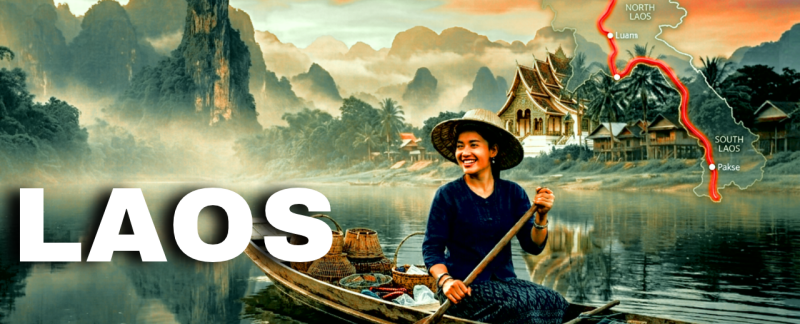
Laos is a country where time seems to slow down. The rhythm of life is accompanied by peace and wholesomeness. There is no rush to anything, as if the world around moves at its own pace.
And then come the landscapes that completely transform the way you perceive beauty. Towering mountains emerge from forests and sit quietly on the horizon. Vast yet calm rivers flow through the countryside. Centuries-old traditions remain alive in everyday practices. Silky turquoise waters cascade down limestone cliffs, as if every corner has its own share of beauty.
A sunset over the Mekong is as calming as standing beside the turquoise waters of Kuang Si Falls. Listening to monks chant ancient prayers can be just as moving as sharing a quiet cup of Lao coffee. This is more than a journey. It is an expedition into a land where wild landscapes, enduring culture, and deep spiritual devotion exist in remarkable harmony.
Vientiane: Discovering the Quiet Heartbeat of Laos
The pulse of Laos can be measured right here, in its capital city of Vientiane. It is laid-back, calm, and still deeply connected to its culture. This city moves the way a tuk-tuk moves through its streets: unhurried, a little worn at the edges, with old buildings standing shoulder to shoulder with colonial architecture. But to really understand Vientiane, you have to slow down, get off the road, and step into its temples.
Wat Sisaket: A Sanctuary of Thousands of Buddha Statues
This is Wat Sisaket, the oldest surviving temple in Vientiane. Legend says that when Thai forces destroyed nearly everything else in the city, they spared this temple because of how it was built. Its architecture resembled that of a Thai temple.
Look at the layered roofs, the serpents curling along the edges, and the rows of pillars that have stood for centuries. Everything about this temple is unique. As you slowly walk through its vast courtyard, you begin to understand why this place, of all places, was left untouched. But walk a little further inside, and you will discover what this temple is really known for: thousands of Buddha statues.
Here, there are over four thousand Buddha statues, and somehow, no two of them are quite the same. Some tower above you, while others are smaller than your palm. Some sit with their eyes gently closed, while others appear open and watchful. Some are carved from wood, others cast in metal, and some cut straight from stone.
Every posture is different. Every face carries its own quiet expression. Look closer at the walls, and you will notice thousands more Buddha statues tucked into tiny niches, layered row after row. When these smaller statues are included, the total number climbs to nearly ten thousand.
Over time, this temple became something more than a place of worship. It became a sanctuary for statues brought here from temples that did not survive, preserving a remarkable part of Laos’s religious history. Follow the path behind the temple into the monastery. This is where the silence changes shape. You hear it before you see it: bare feet on stone, the soft rustle of saffron robes, and the quiet presence of the monastery buildings.
The monks walking these grounds today are part of a long tradition associated with this temple. In their saffron robes, they are living proof that in Laos, history is not simply kept behind glass. It is worn, practiced, and breathed every single morning.
Wat Si Muang: Where Faith Remains Part of Everyday Life
Wat Sisaket gives you centuries of history held still in wood, stone, and metal. But to experience living culture in real time, we head to a temple where traditions continue through everyday rituals and sacred practices: Wat Si Muang.
The moment you arrive, you can sense the difference. The liveliness, the architecture, the statues, and the walls all reflect a culture that is not meant to be admired from a distance. This is a place people visit every day because of what it represents to them: the very spirit of Vientiane itself.
You can see that belief in the smallest details, including sacred marigolds and peepul leaves, some wrapped in gold and others in silver. These are small offerings, but they carry significant meaning.
Once you enter the courtyard, take a moment to absorb everything around you. Stop, observe, and let the atmosphere settle in. It may seem like a lot to take in at first, but the more you observe, the more you begin to understand. Step inside the main temple, and the experience changes completely. There is peace, without any sense of rush. Everything is vibrant yet calm at the same time.
Pillars lined with intricate glasswork catch every flicker of light. Colourful paintings and patterns stand out against golden details, creating an atmosphere that feels sacred the moment you walk in. But what makes this place truly different is not simply what you see. It is who you see it with. Locals kneel before a priest, their hands pressed together and their eyes closed, asking for something real. A new job. A new marriage. A new beginning.
This is not a reenactment of culture. It is the culture itself, as ordinary and essential as breakfast. And for a few minutes, you are not just watching it. You are already a part of it.
Vientiane After Dark: From Prayer to Celebration
Faith in Vientiane does not remain behind temple walls. It simply changes shape, moving from silence to celebration. As night begins to fall, Vientiane reveals another side of itself. The air fills with smoke and spices. Woks hiss. Fish, prawns, and river crabs are laid across open flames right in front of you.
The streets that felt so still during the day suddenly become lively, filled with music and the unmistakable sounds of a city enjoying its evenings. Walk through these streets, and you realise that Vientiane was never just about stillness. It is about balance.
It is a city that prays in the morning and feasts by night. Devoted yet unpretentious. Ancient yet alive. This is Vientiane, the quiet heartbeat of Laos.
Vang Vieng: Where Mountains Meet Adventure
Leave the capital behind, and the rhythm of the country begins to change. The roads stretch north. The buildings slowly disappear. The landscape opens up, first into countryside and then into mountains, until limestone peaks begin to rise dramatically from the horizon.
This is Vang Vieng, a place where the calm of Laos meets its wildest landscapes. And this is where our journey continues.
Tham Chang Cave: A Journey Into the History of Laos
Our first stop is Tham Chang Cave, a place where nature and history have been quietly intertwined for centuries. From Vientiane, Vang Vieng is roughly a two-hour journey by road. The journey itself is part of the experience. The road winds through the Lao countryside, past mountains, small villages, green fields, and long stretches of untouched landscape.
Tunnels cut through the mountains, while towering limestone formations begin to appear in the distance. You can feel the landscape changing long before you reach Vang Vieng. And then, suddenly, the mountains are everywhere. After arriving near Tham Chang Cave, we paid a small entrance fee and began making our way towards the cave. The path takes you towards the Nam Song River.
During the dry season, crossing the river can be a simple walk across a small bridge. But during the rainy season, when flooding becomes more common, these crossings can change completely. Wooden bridges can disappear beneath the water, and boats sometimes become the only way across.
Even before reaching the cave, there is something peaceful about this place. Near the base of the mountain is a small, crystal-clear pool. The water comes from underground, flowing naturally through the limestone before emerging here. For generations, this water was more than just a beautiful natural feature. It was a source of drinking water for people who sought refuge in these caves during times of conflict.
Today, the same water offers something much simpler: a place to cool down. You can even rent a tube and explore the small water cave nearby. But Tham Chang is not simply a cave hidden inside the mountains. It carries a story.
During the nineteenth century, conflict and invasions swept through this region. Thousands of local people came here seeking protection in these dark caves. The caves provided concealment, and the underground water provided something even more important: a way to survive.
It is difficult to imagine that history while standing here today. The water is clear. The mountains are quiet. The forest is green. And yet, beneath this peaceful landscape lies a memory of a much more uncertain time.
Exploring the Limestone Formations Inside Tham Chang Cave
From the parking area, the walk towards Tham Chang takes around fifteen minutes, followed by a short climb. Then you reach the entrance, and everything changes. A cool breeze moves out from the darkness of the cave. The temperature drops. The bright sunlight disappears behind you, replaced by dim light, damp air, and the earthy smell of limestone and minerals.
It feels like stepping into another world. Inside, Tham Chang is far larger than it first appears. Massive limestone formations hang from the ceiling, while others rise from the ground. The walls are covered with patterns created slowly by water, mineral deposits, and time.
This is where the cave becomes more than just a place to explore. It becomes a geological record. In several places, the limestone takes on reddish and brownish tones. These colours can come from clay minerals and other impurities carried into the cave by water flowing from the surface. Over time, they become part of the cave itself.
To us, they may simply look like beautiful colours on the walls. To geologists, they can tell a much deeper story about water movement, cave formation, and the environmental conditions that shaped this underground world.
In certain places, the walls begin to sparkle. At first, it almost looks as if someone has scattered glitter across the rock. But the sparkle is entirely natural. Tiny calcite crystals catch the light at just the right angle, reflecting it back from the surface.
Then come the formations most people imagine when they think of a limestone cave. Stalactites hang from the ceiling like frozen stone. Stalagmites rise from the ground like candles slowly turned to rock. Some are thin and delicate, while others are massive. Where formations from the ceiling and floor eventually meet, they become enormous natural pillars.
Nothing here was built quickly. Nothing was designed. Water simply kept moving, minerals kept accumulating, and time did the rest. When you finally step back outside, the contrast is almost overwhelming. After the darkness and silence of the cave, the valley suddenly feels enormous.
Sunlight returns. The Nam Song River winds through the landscape. This is the landscape that made Vang Vieng famous. Today, the town is known around the world for adventure: kayaking down the Nam Song, floating through caves, hiking into the mountains, and watching the valley from above in a hot-air balloon.
In Vientiane, the story of Laos is carried through prayer and tradition. Here in Vang Vieng, it is written in limestone, water, mountains, and time. And Tham Chang Cave is where that story begins.
Angel Cave Zipline: Flying Above the Jungle
Vang Vieng is not a place that asks you to simply observe. Once you have seen its mountains from the ground, the natural thing to do is climb higher, leave the caves behind, step above the trees, and see the landscape from a completely different perspective.
Just a few kilometres north of town, along the Nam Song River, lies Angel Cave, where one of the more adventurous ways to experience this landscape awaits: a journey across the jungle canopy by zipline.
Before the adventure begins, there is a little preparation. The zipline team takes you through the safety instructions and gets you fitted with the necessary equipment, including a helmet and harness. It feels routine at first. But then you look at the line disappearing into the forest, and suddenly, the height becomes very real.
The course consists of seven connected ziplines, each taking you deeper into the landscape. Together, the lines stretch for roughly one and a half kilometres. Some sections pass high above the forest, while others carry you between limestone cliffs and across open stretches of the valley.
As you leave the platform for the first time, the ground disappears beneath you. For a few seconds, you are no longer walking through Vang Vieng. You are flying through it. The jungle moves beneath your feet. The wind rushes past. Suddenly, the landscape that seemed so vast from the ground becomes a living map below you.
In the cave, everything felt ancient and still. Here, everything is moving. The lines are set at different heights and lengths, making each section feel slightly different. Some are shorter and closer to the forest, while others open up into much wider views.
And then comes the final line, the longest of the seven. Roughly four hundred metres long, it stretches across the Nam Song River. This is where the experience truly opens up. There is nothing immediately beneath you except the river and the valley.
If you do not have a GoPro, there is also a simple way to capture the experience. Your phone can be secured to your hand with a small strap, allowing you to record as you move through the course. But even while filming, it is worth putting the camera down for a moment. Some landscapes are better experienced than recorded.
Vang Vieng is often described as the adventure capital of Laos, and it is easy to see why. But what makes these activities special is not simply the adventure itself. It is the landscape that surrounds them. Every activity becomes another way of entering that landscape. Ziplining simply gives you the chance to see it from above.
After the final line, you return to the ground. The adrenaline slowly fades. The helmet comes off. Near the entrance, there is a small riverside restaurant where you can sit down, enjoy some local food, and watch the Nam Song flow past. After moving through the forest at full speed, this quiet moment feels just as rewarding.
Tham Chang Cave showed us a landscape shaped slowly by water and time. The zipline shows us the same landscape in motion. And as we continue deeper into Vang Vieng, there is still much more to discover.
Blue Lagoon 2: A Refreshing Escape Into Nature
We hit the road out of town towards the blue lagoons, bumping along a rustic path that cuts through mountains and forest. The blue lagoons are small, blue lakes tucked among the limestone landscapes of Vang Vieng. There are five of them, and we are heading to Lagoon Two, which is usually quieter than the others.
After paying a small entrance fee, we jumped straight into the water. It was incredibly refreshing. We ended up staying almost two hours there, simply floating and relaxing. Sometimes, the best travel experiences are not about doing more. They are about finding a beautiful place, slowing down, and enjoying the moment.
Sunset Boat Ride on the Nam Song River
As the afternoon light began to fade, we made our way to the Nam Song River for a sunset boat ride.Along the way, we passed ATVs and hot-air balloons, offering a glimpse of the different ways travellers experience the mountains, valley, and town below.
Sunset boat rides are not about speed or adrenaline. They are about stillness, towering limestone cliffs, a changing sky, and everyday riverside life drifting past. A typical ride lasts almost an hour. It is smooth, steady, and easy, making it an experience that almost anyone can enjoy. It is also a wonderful way to unwind in the evening.
The scenery keeps changing throughout the journey. You drift past floating bars, bamboo bridges, green fields, and riverside cafés, catching little glimpses of local life before the sun goes down. The light turns golden. The heat begins to fade. Limestone peaks reflect in the water, and the sky moves through warm colours. The slow pace gives you space to take it all in.
A Surprising Visit to the Local Market
As we planned to head back, our guide suggested taking us to the local market. And the market was full of surprises. The kinds of things being sold were beyond my imagination. Maggots, bear meat, ducks, bats, and much more were on display alongside plenty of vegetables.
We grabbed some fruit and headed towards one of the most peaceful and colourful sunset experiences of my life. Dusk had already settled over the mountains, and things had quietened down. You might catch faint music or chatter drifting from town, a soft transition from dusk into a peaceful night.
It was the kind of moment that stays with you forever. Vang Vieng is a place that rewrites everything you know about peace and adventure. It is not just a stop on a map. It is a feeling that stays with you long after the sun goes down.
Luang Prabang: Discovering the Spiritual Soul of Laos
The next morning, we started exploring on foot, completely unplanned.
And that was when the trip began to feel much more personal. For the first time, I experienced Buddhism in a completely different way, not through a book or a documentary, but simply by being there in the moment.
Exploring Buddhist Temples and Living Traditions
While walking, we came across a Buddhist temple that was incredibly beautiful. Golden pillars, red and gold interiors, detailed woodwork, and intricate decorations filled the space.
But there was something more to it, something much harder to explain. The temples felt incredibly still, almost as if life had slowed down inside them. Then I witnessed something I had previously seen only in photographs. A local woman had arrived with offerings for the priest.
This beautiful act of giving reflects an important part of Buddhist practice. Through these offerings, the local community supports monks and priests, helping Buddhist teachings continue to flourish. Giving can also encourage detachment: learning to let go, to give, and to grow in compassion. While the community supports the monks, the monks provide spiritual guidance and help preserve Buddhist teachings and values.
Seeing all of this happen right in front of me made the tradition feel very real. But here is something I found even more fascinating. How do you preserve teachings for centuries, especially in a time when most people could not read or write?
The answer was right in front of me: through art. Temple walls had become storytellers. Scenes from Buddhist teachings, local legends, and moral lessons were beautifully painted across the walls.
The Meaning Behind the Golden and Red Colours
There was one colour that caught my attention: gold.
Golden details were everywhere, and there was a reason behind it. Gold is closely associated with enlightenment and purity, representing the highest spiritual goal in Buddhism. That is why it is one of the most dominant colours in many Buddhist temples.
Then there was red, creating a striking contrast. Gold is often associated with enlightenment, while red can represent earthly life and its struggles. Together, these colours create a powerful visual experience that invites reflection on the journey beyond worldly suffering and towards spiritual understanding.
After admiring the artwork from the outside, it was finally time to enter the main temple. The first thing I noticed was the peace. There were hardly any people inside. No huge crowds, no constant noise, just open space and the feeling that time had slowed down.
Let me ask you something: when was the last time you visited a UNESCO World Heritage site and had an entire temple almost to yourself?
The Buddha Statue and the Beauty of Gold Leaf
Then we saw the main Buddha statue, and one of my long-standing assumptions was completely broken. I had always thought these golden Buddha statues were simply painted gold. But as I looked closer, I saw people carefully applying thin sheets of gold leaf to cover the statue.
It was a small detail, but it changed the way I understood the experience. The golden surface was not simply decoration. It was also connected to an ongoing act of devotion. In front of the main Buddha statue were dozens of smaller figurines, arranged on tiers behind and around the central figure. These are known as attendant figurines.
There were also small tables, vessels, and decorative stands arranged on the floor for rituals and offerings. Once you look around, the vastness of the hall opens up. Thick wooden pillars are decorated with gold stencils, while the walls are covered in detailed murals.
In many temples, you will also notice drums and golden shrines. Temple drums are used for ritual signalling, marking the start and end of Buddhist holy days, prayer sessions, and meditation hours. Golden shrines, sometimes called busabok, are used to display and protect religious relics or scriptures. We sat there for quite some time, quietly. No talking, no rushing, just sitting. And honestly, it felt like we needed that moment. Sometimes, you do not realise how much you need a pause until you finally get one.
Inside a Buddhist Monastery
After a while, we stepped outside, and another surprise was waiting for us. The temple complex was not just about the temple. It also housed a monastery. This was the first time I had seen a monastery from such a close perspective, and what immediately caught my attention was its simplicity. Small living quarters. Very few modern distractions. Nothing felt excessive.
Some monks were heading out for alms, while others were working around their quarters. We spent some time enjoying this glimpse into the everyday lives of monks. It was a side of Buddhism that you rarely understand simply by visiting a temple as a tourist.
Discovering Another Temple, Traditional Rituals, and a Small Museum
We spent some time observing the monks’ daily lives before heading out. We had hardly walked a hundred metres when we came across another temple. Although we did not spend much time there, this temple felt different. It was not as heavily decorated as the previous one, but beautiful flower offerings, including marigolds, were displayed throughout the grounds.
The flowers added a completely different feeling to the temple. Then we noticed something I had never seen before: a wooden fortune-slip cabinet. It had numbered compartments. Visitors could draw a number and then find the matching slip. Each slip contained a traditional fortune or a piece of advice.
It was almost like receiving a tiny message from the temple. Nearby were traditional red-and-gold round ritual trays used to hold offerings such as incense, candles, and flower garlands. And just when we thought we had seen everything, we discovered a small museum inside the temple complex. There were old artefacts, religious objects, and many Buddha statues in different postures, each posture carrying its own meaning.
After exploring these temples, we finally headed back towards town. But as we returned, the streets looked completely different at night. Somehow, even the familiar surroundings had taken on a new atmosphere.
Kuang Si Falls: The Turquoise Waterfalls of Laos
Everyone talks about Luang Prabang for its temples, but some of the most incredible experiences are actually outside the city. In just one day, you can swim in turquoise water, walk into a sacred cave filled with thousands of Buddha statues, visit a traditional village, and finish the day watching the sunset over the Mekong River.
This journey begins at one of the most beautiful places in Laos: Kuang Si Falls. Located about thirty kilometres from Luang Prabang, the waterfall is reached by a scenic drive through forests and mountains. Once you reach the entrance and walk a little further into the forest, the first thing you notice is the colour of the water.
It looks too blue to be real. The series of pools has an unusual milky-turquoise colour influenced by the limestone-rich water. These natural terraces have been forming over long periods as mineral deposits accumulate. The lower pools are where most people stop to swim. And honestly, this is one of those places where a camera cannot fully capture what it feels like to be there.
The water is incredibly refreshing, surrounded by jungle and the sound of falling water. If you do not want to swim, you can simply follow the path alongside the pools and enjoy the views. The closer you get to the main waterfall, the more impressive it becomes. The main waterfall drops roughly two hundred feet, creating one of the most beautiful cascades you will see in Laos.
Near the entrance, there is also a bear rescue centre. The bears here have been rescued from illegal wildlife activities. After spending a refreshing morning at Kuang Si Falls, we made our way towards the Mekong River. The next part of the journey would take us somewhere completely different.
Pak Ou Caves: Thousands of Buddha Statues Hidden Inside Limestone Cliffs
Our next destination was Pak Ou Caves, also known as the Buddha Caves. These caves are located near the meeting point of the Nam Ou and Mekong rivers, and you can reach them by boat. Getting there by river makes the journey feel very different from simply driving to another destination.
Once you board the boat, the landscape opens up into forested mountains, countryside, and long stretches of the Mekong River. This is one of those parts of Laos where you do not necessarily need something happening every few minutes. Sometimes, the journey itself is the experience.
You sit on the boat, watch the mountains move past, and begin to realise how deeply life in Laos has always been connected to the river. After some time, the boat reaches the caves, built into a limestone cliff overlooking the Mekong. From the outside, they may not immediately look like a remarkable religious site. But wait until you step inside. There are two main caves. The lower cave is easier to reach, while the upper cave requires climbing around two hundred steps. Once you walk inside, you begin to understand why people have been coming here for centuries.
Inside the Lower Cave: A Hidden Collection of Buddha Statues
The lower cave is filled with Buddha statues, not in hundreds, but in thousands.
There are almost four thousand Buddha statues inside the lower cave. Pilgrims placed these statues here over time, creating an extraordinary collection of religious offerings. Some statues are large, while others are tiny. Some remain in good condition, while others appear weathered by time. Some sit on ledges, while others are tucked into dark corners. Some are made from metal, while others are wooden. And that is what makes the cave so interesting. Every statue has its own appearance, yet all of them contribute to the same remarkable spiritual atmosphere.
The site has a long association with Lao royalty, who historically visited the caves as part of religious traditions. But the upper cave offers a completely different experience.
As you climb higher and move deeper inside, the atmosphere becomes darker and quieter. The darkness of the cave, combined with the Buddha statues, creates a feeling unlike anything you experience in the lower cave. It is a reminder that some of Laos’s most fascinating cultural sites are not grand palaces or elaborate monuments. Sometimes, they are quiet spaces hidden inside the landscape.
Whiskey Village: Traditional Lao Rice Whiskey
After exploring the caves, we headed to a whiskey village.
Here, rice whiskey is still produced using traditional methods. The village offers a glimpse into local craftsmanship and the way certain traditions continue to be practised across generations. One of the most unusual things you may encounter is rice whiskey containing preserved snakes or scorpions, traditionally associated with vitality. It is a very different experience from visiting temples or waterfalls, and another reminder of how diverse a journey through Laos can be. But there was still one more side of the country that we were going to experience, and this one was much smaller and more personal.
Visiting a Traditional Hmong Village
Our next stop was a traditional Hmong village.
The community continues to preserve aspects of its traditional way of life. We saw old tools used for preparing fabrics, stone mills for grinding grain, wooden tools for pounding rice, and much more. The village also offered a glimpse into Hmong music and social traditions.
One instrument you may hear in this part of the country is the khene, a traditional Lao mouth organ. Music has long been associated with celebrations, social gatherings, and courtship. We did not spend much time there, as this was never meant to be the main attraction of the day. It was more like a small window into another side of Laos.
After visiting the waterfall and caves, the experience reminded me that travel is not always about finding the biggest or most spectacular place. Sometimes, a few simple details can tell you more about a country than a famous landmark.
Sunset Cruise on the Mekong River: The Perfect End to the Day
By this point, we had been moving almost all day. Instead of rushing back and ending the day there, we saved one final experience for the evening. We returned to the Mekong River to watch the sunset while making our way back towards Luang Prabang.
The Mekong is one of those rivers that can feel completely different depending on where and how you see it. During the day, it can look busy and powerful. But around sunset, everything slows down. The light becomes softer, the mountains turn into silhouettes, and the river begins reflecting the sky.
We joined a sunset cruise on the Mekong. At first, the sunset did not look particularly dramatic. The sun was still high enough that everything was washed in ordinary afternoon light. But slowly, the colours began changing. The mountains grew darker. Reflections became longer. The sky turned from blue to orange and then into deeper shades of red and purple.
This is the part of the day when you really do not need much narration. You just watch. The sunset boat ride did not feel like the end of the journey. It felt like the experience that had been quietly connecting the entire day. We had followed roads through the mountains, travelled by river to the caves, and visited local communities. Now, we were sitting directly on the Mekong, watching the sunset over the same river that has connected people, villages, trade routes, and cultures for centuries.
The waterfall showed us the raw landscape. The caves revealed a part of the region’s spiritual history. The village offered a glimpse into its living culture. And the Mekong tied all of it together. This experience is not only about watching the sunset. It is about being on one of the world’s great rivers, surrounded by timeless landscapes and sharing a moment of peace with other travellers and locals.
It is also one of the most relaxing ways to end a busy day of sightseeing. Whether you are a backpacker, a couple on a romantic getaway, or a family travelling together, a Mekong River sunset cruise is a wonderful way to wind down your day. It will leave you with incredible memories of Laos, because the best part of a trip is not always a single place. It is how quickly the landscape, culture, history, and river can change around you while somehow still feeling like one continuous journey.
Wat Sen: An Unexpectedly Peaceful Temple in Luang Prabang
The next day, we began our journey at Wat Sensoukharam, also known as Wat Sen. And the wildest thing about this place was that I was standing in the middle of a world-famous UNESCO World Heritage site, completely by myself, with no other tourists around.
Famous for its towering golden pillars, this magnificent temple is traditionally associated with the use of hundreds of thousands of stones brought from the Mekong River during its construction. As soon as you step inside, the deep red and gold façade stands out beautifully alongside the traditional double-tiered roofs.
The complex features multiple buildings that are beautifully decorated and preserved. We walked through the peaceful, white-painted monks’ quarters, where an unmistakable sense of calm filled the air. But if you want to see what a real classroom looks like for young monks, you have to explore deeper into the grounds. We discovered the local Dhamma halls, where young monks attend their daily classes. Inside every building we visited, we found a main Buddha statue accompanied by intricate smaller attendant figurines. It offered a rare and uninterrupted glimpse into a culture that most travellers only ever see from the outside.
Conclusion: Laos Is More Than a Destination
From the quiet temples of Vientiane to the dramatic limestone mountains of Vang Vieng, and from the turquoise waters of Kuang Si Falls to the sacred caves and peaceful riverbanks of Luang Prabang, Laos offers a remarkable variety of experiences. But what makes the country truly special is not simply its landscapes or its famous landmarks. It is the way everything seems connected.
Faith remains part of everyday life. Traditions continue through generations. Rivers shape the landscape and connect communities. Mountains hold stories of the past, while villages preserve ways of life that still matter today. And throughout the journey, there are moments when you find yourself slowing down without even realising it.
Perhaps that is the real beauty of Laos.
It reminds you that travel does not always need to be rushed. Sometimes, the most meaningful experiences happen when you stop trying to see everything and simply allow yourself to be present.
Laos is a country of remarkable landscapes, enduring traditions, and quiet moments that stay with you long after you leave.
Welcome to the Land of a Million Elephants.